ENTER THE VOID.EXPLORE IN 3D.
Run the numbers behind deep space. An interactive astrophysics observatory mapping 219 exoplanets, 6 charted galaxies, and 5 supermassive singularities at university depth.
Gateways Across Deep Space
Enter focused astronomical observation domains. Each celestial harbor features authenticated physics, Keplerian orbits, and progressive deep inspection.
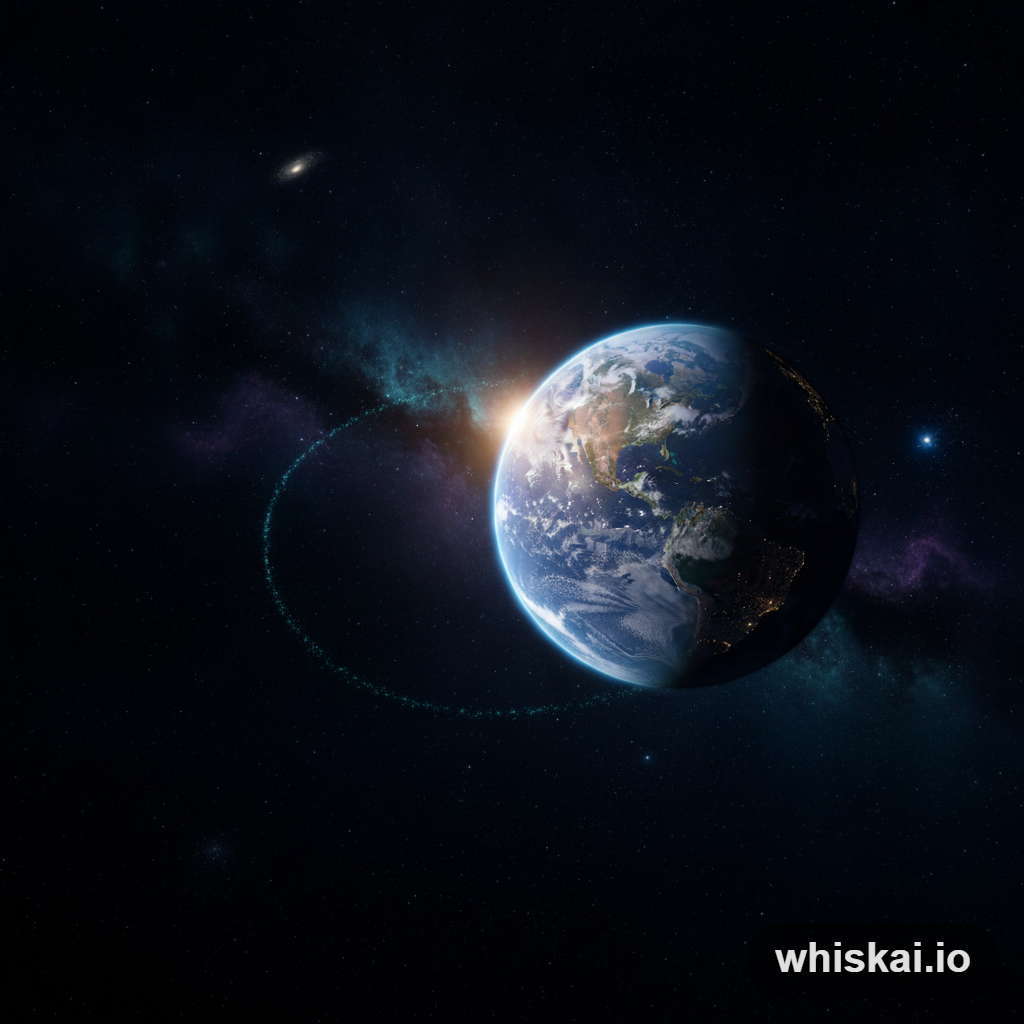
The Solar System
Explore Earth, Mars, Jupiter, Saturn, and the asteroid belts with authentic physical scales, axial obliquity, and real orbital resonance periods.
Galaxies & Deep Space
Fly through spiral nebulae, stellar nurseries, and six charted galactic structures including the Milky Way and Andromeda core.
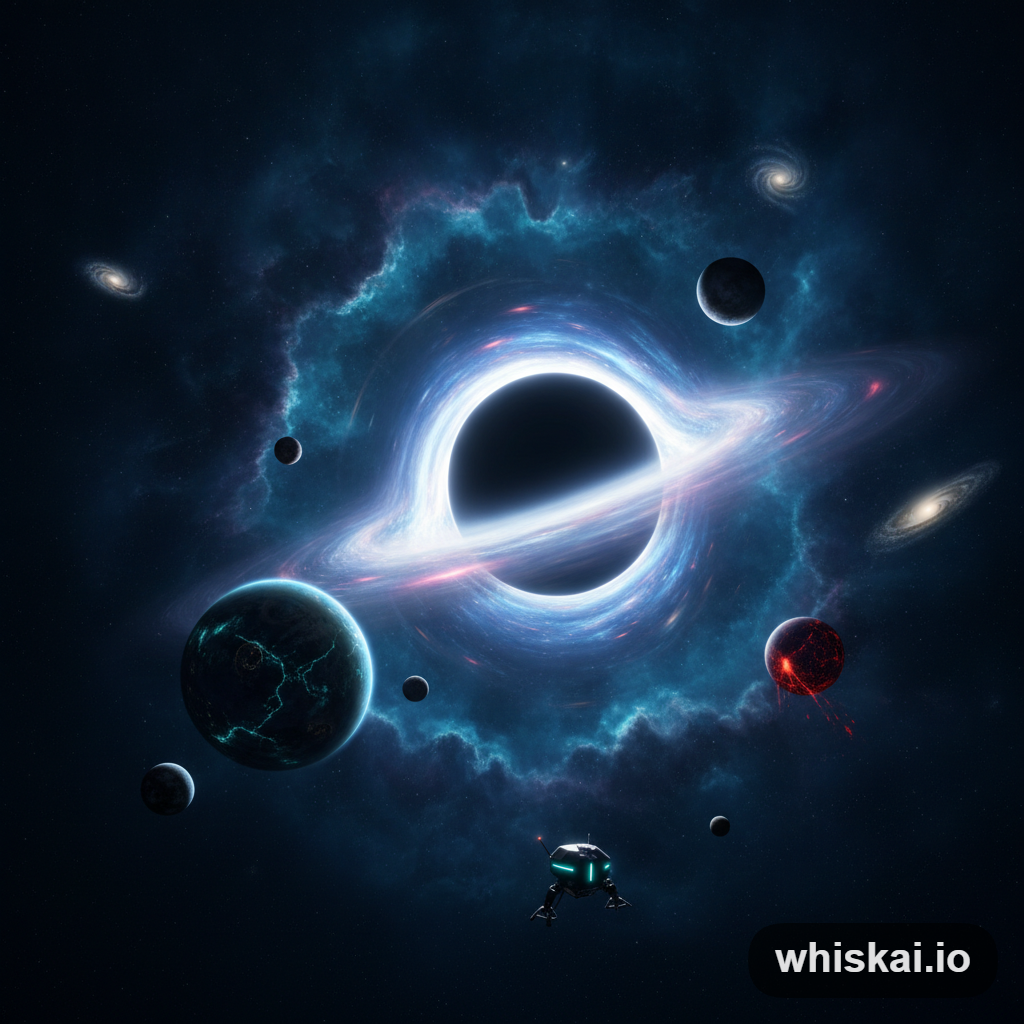
Black Holes & Horizons
Witness gravitational lensing, spinning relativistic accretion disks, and event horizons calculated from Einstein’s general relativity tensor.
The Three Phases of Exploration
A seamless voyage from spectral calibration to true relativistic gravity calculations. University physics rendered tangible in real-time 3D.
Pick a Galaxy & Calibrate Spectrum
Select floating stellar spirals in the dark. Adjust absorption spectrums and tune the wavelength receivers from hydrogen-alpha to cosmic gamma bands.
Orbit Body & Dosimetry Readout
Fly close to any charted exoplanet or lunar body. Compute exact orbital mechanics, radiation millisieverts, and human biological viability limits.
Relativistic Horizon Computation
Enter the ergosphere of Kerr-metric black holes. Calculate frame dragging, time dilation factors, and gravitational redshift in interactive space.
“The same sky, different questions, same universe.”
SHUNYA dismantles ornamental science software. Here, astrophysics is conducted through unvarnished mathematical tensors, authenticated mission telemetry, and uncompromised precision.
Official institutional partners providing academic supervision and speculative laboratory representations.
Habitability Analysis
Atmospheric retention, magnetospheric shielding, liquid water equilibrium curves.
Mission Architecture
Tsiolkovsky delta-v budgets, cryogenic transfer orbits, payload optimization.
Small-Body Science
Spectrophotometry of Asteroid Bennu, carbonaceous chondrite assay, deflection mechanics.
Stellar Physics
Hertzsprung-Russell evolution, CNO cycle fusion equilibria, core degenerate collapse.
Relativistic Horizons
Accretion disk magnetohydrodynamics, synchrotron beaming, event boundary physics.
Impact Modeling
Kinetic energy dissipation, transient crater scaling, atmospheric blast wave radii.
Two Ways to Master the Universe.
Choose between building physical intuition through interactive 3D simulations, or diving into formal university derivations and mathematical tensors.
Hands-On Cosmic Simulators & Games
Build physical intuition through real-time gameplay. Adjust mass and velocity in 3D gravity wells, manage oxygen and radiation in off-world habitats, decode SETI signals, and navigate orbital maneuvers.
Rigorous Classical Physics & Tensors
For scholars who demand formal proofs and mathematical derivations. Step-by-step Kepler differential equations, Schwarzschild metrics, and Tsiolkovsky delta-v budgets.
Cosmic Theory Mastery Quiz
According to Kepler's Third Law (T² ∝ a³), if an extrasolar planet orbits a solar-mass star at a semi-major axis a = 4.0 AU, what is its orbital period T?
Ready for Orbital Insertion?
CLICK TO ENTER THE UNIVERSAL REPOSITORY
[ HEADPHONES RECOMMENDED // AUDIO FREQUENCY: 432 HZ ]