The Universal Track.One Voyage Across the Cosmos.
No fragmented courses. No confusing side tracks. One continuous voyage from orbital gravity to relativistic singularities, with deep university theory anchored at the end.
Chronological Cosmos Progression
Celestial Mechanics & Orbital Gravitation
"Why don't orbiting planets fall into their host stars?"

3D Planetary Orbit & Velocity Balancer
Watch an exoplanet hurtle towards its sun. Adjust velocity in real-time to watch elliptical orbits stretch, circularize, or reach escape trajectory.
↳ Too low = collision crash; Too high = hyperbolic escape.
↳ LEO requires 7.6 km/s; GEO orbital period equals 24 hours.
Planetary Atmospheres & Habitable Zones
"What stops a world's oceans from boiling off or freezing permanently?"

Goldilocks Radiation Zone Explorer
Drag alien worlds closer or further from their host star. Witness greenhouse runaway boiling, ice-albedo planetary freezing, or balanced liquid oceans.
↳ Inside 0.95 AU: runaway greenhouse. Beyond 1.37 AU: permanent glaciation.
↳ Traps thermal infrared radiation; stabilizes nightside temperature.
Stellar Nucleosynthesis & Fusion Engines
"How do stars manufacture all elements from carbon to gold without collapsing?"
Hertzsprung-Russell Stellar Evolution Lab
Ignite hydrogen fusion in a newborn protostar. Balance outward thermal radiation pressure against inward gravity, or trigger a massive core-collapse supernova.
↳ < 0.08 M☉ = brown dwarf; 1.0 M☉ = white dwarf; > 8.0 M☉ = supernova & neutron star; > 25 M☉ = black hole.
↳ At 15M K: Proton-Proton chain dominates; > 20M K: CNO catalytic cycle takes over.
Relativistic Horizons & Black Hole Singularities
"What actually happens to space and time when gravity becomes infinite?"
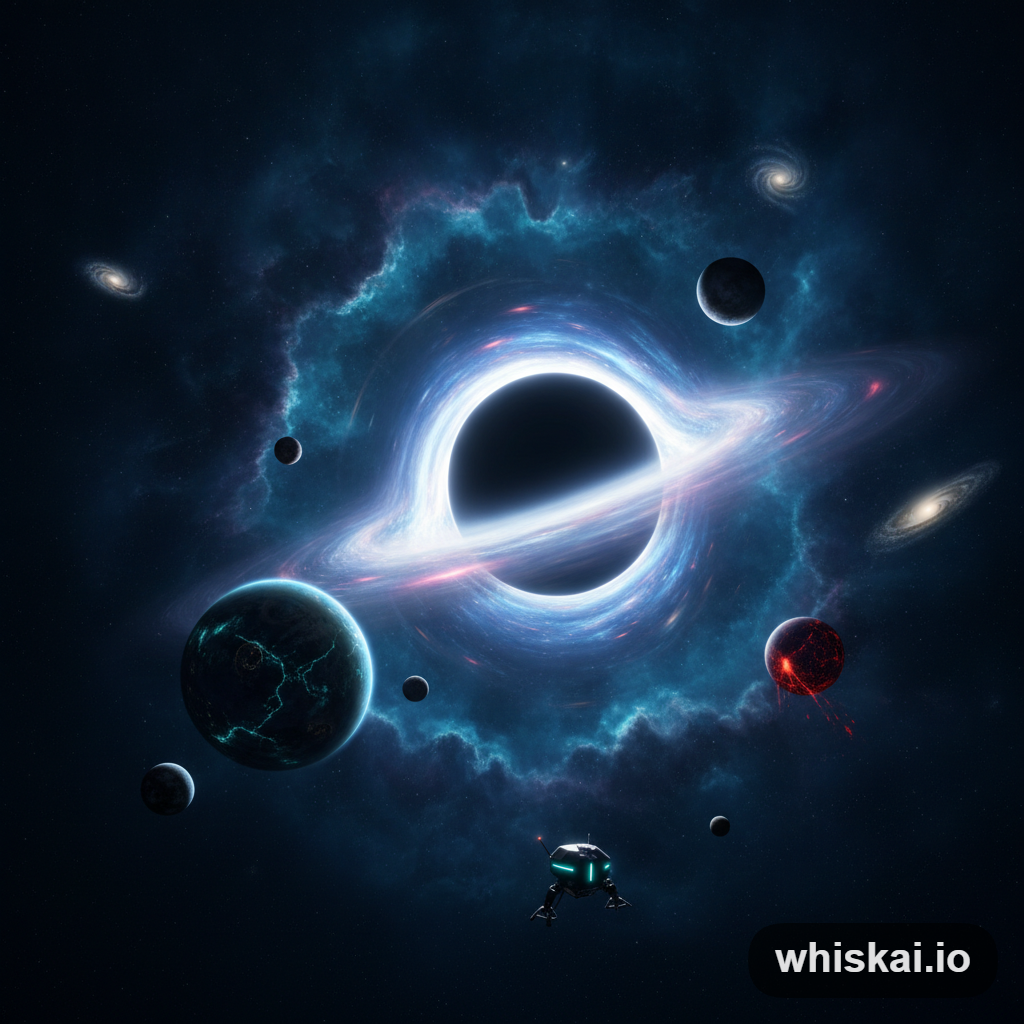
Relativistic Ray-Tracing & Event Horizon
Fly a probe into the accretion disk of Sagittarius A*. Experience gravitational time dilation, gravitational redshift, and Einstein ring lensing.
↳ Schwarzschild radius scales linearly: 3 km per solar mass (Sgr A* r_s ≈ 12.4M km).
↳ Higher spin drags spacetime into an oblate ergosphere; frame dragging exceeds speed of light.
Cosmic Evolution & Observable Horizons
"What is the ultimate geometry, age, and fate of our expanding cosmos?"
13.8 Billion Year Expansion Timeline
Travel from the Big Bang inflationary singularity, through the release of the Cosmic Microwave Background (2.725 K), to the accelerated dark-energy expansion.
↳ Determines the current cosmic expansion rate and Hubble horizon size.
↳ Drives repulsive negative pressure causing exponential accelerating expansion.
Mathematical Foundations of the Cosmos
As requested by the pedagogical directive: Theory At Last. After observing the phenomena and running the visual experiments, review the canonical mathematical proofs that govern the universe.
Harmonic Period From Gravitational Centripetal Balance
For a circular orbit of radius r and orbital period T, the centripetal acceleration is supplied entirely by the Newtonian gravitational force:
Consequence: The square of the orbital period is directly proportional to the cube of the semi-major axis. Valid for all planetary orbits around Sol and all exoplanets cataloged in SHUNYA.
Event Horizon Escape Threshold (v_esc = c)
From energy conservation in Newtonian mechanics (and confirmed rigorously by setting the g₀₀ component of the Schwarzschild metric to zero: 1 - 2GM/c²r = 0):
Consequence: Within radius r < r_s, all timelike geodesics point toward the central singularity r = 0. Time and radial coordinate swap roles in the metric tensor.
Delta-V Yield From Momentum Conservation
As propellant is expelled at effective exhaust velocity v_e, momentum conservation dictates m·dv = -v_e·dm:
Consequence: Governs every real space mission in the SHUNYA archive (Apollo Lunar Orbit Insertion: Δv ≈ 820 m/s; Chandrayaan-3 Trans-Lunar Injection: Δv ≈ 3,200 m/s).